



Modern B2B buyers do not wait. They raise their hand, expect a fast and relevant reply, and move on to whoever answers first. That reality has turned speed-to-lead into one of the sharpest dividing lines in B2B sales, and it is the lens I want to use to compare two very different growth models: an AI platform like B2B Rocket and a human-led agency like IronPaper.
Let me be clear and fair up front. IronPaper is a respected B2B lead-generation and demand-generation agency with strong strategy, content, and analytics chops. This is not a case of good versus bad.
It is a case of two models built on different engines. One runs on human expertise and human timelines. The other runs on autonomous AI agents that engage, optimize, and scale at machine speed.
In this post I will put both models against four modern tests: speed-to-lead, real-time optimization, data accuracy, and global reach. By the end you will see where a human-led agency shines, and where an AI engine pulls ahead for teams that live and die by pipeline velocity. You can also read our cost-focused B2B Rocket vs. IronPaper comparison for the ROI angle.
Speed is not a nice-to-have anymore. It is the customer experience. When a prospect reaches out, they are actively thinking about a solution right then, and every minute you wait lets that intent cool.
The data is blunt. The MIT and InsideSales Lead Response Management study found that reaching a lead within five minutes makes you roughly 100x more likely to make contact and 21x more likely to qualify than waiting 30 minutes. Yet the average B2B team takes around 42 hours to respond, and about 78% of buyers buy from the first vendor that gets back to them. The first response wins.
Here is the challenge for any human-led model, agency or in-house. A person has to notice the lead, pick it up, and craft a reply, and that person is not awake and available every minute of every day. An AI engine does not have that limit. It engages every inbound lead in seconds, at any hour, with a response that is both instant and on-brand. Tools like AI email auto-reply make sub-60-second engagement the default rather than a stretch goal.

This is where the engines really diverge. To their credit, a strong agency like IronPaper is data-driven and refines campaigns on an agile, iterative basis. That is genuinely good practice, and better than many.
But there is a ceiling on how fast humans can iterate. A person reviews the numbers, forms a hypothesis, updates the campaign, and waits for the next batch of results, all on a human schedule. An AI engine compresses that loop to near zero. It runs A/B tests continuously, learns from every send, and adjusts messaging and targeting automatically across thousands of interactions at once. The difference is not agile versus not agile. It is human-paced iteration versus continuous, automated optimization at machine speed.
When optimization happens in real time, your worst-performing messages get corrected in hours, not weeks, and your best-performing ones scale immediately. That tighter loop compounds. Over a full quarter, it is the difference between a campaign that slowly improves and one that improves constantly.
Speed and optimization only pay off if you are aiming at the right people, and that is a data problem. The uncomfortable truth is that B2B data rots fast. Contact data decays at roughly 22.5% per year, and some studies put it as high as 30% to 70% annually depending on how many fields you track.
A human list-building process, however careful, produces a snapshot that starts aging the moment it is finished. An AI approach works from large, continuously refreshed data and enriches records at the point of use, so precision holds up over time.
That is the idea behind our AI data enrichment and real-time intent data: you reach the right person, at the right company, while the signal is still fresh. One B2B Rocket user, Arsalan, credited our data-driven approach with delivering high-quality leads and accurate insights, and tied it to a clear lift in conversion rates and revenue.
Account-based marketing lives or dies on reaching the full buying group, often across regions and time zones. This is where a human-led model runs into simple math. A team's live coverage is bounded by how many people it has and the hours they work. Nights, weekends, and distant time zones create gaps, not because anyone is doing a bad job, but because people cannot be everywhere at once.
An AI engine does not share that limit. It runs campaigns 24/7, engages accounts in parallel, and follows up across channels no matter where the prospect sits. A buyer in New York and another in Singapore get the same timely, on-brand touch.
With multichannel outreach, that coverage spans email and beyond without adding headcount. One B2B Rocket user, Eurie Jay P., found deploying AI agents across multiple channels simple and hassle-free, and appreciated managing several agents from one clean dashboard. That is global reach without a global payroll.
So which model fits you? I think of it plainly.
Choose a human-led agency when you value hands-on strategic partnership, nuanced creative, and a team that will sit with your brand and shape a long-term program. That expertise is real, and for some companies it is exactly right.
Choose an AI platform when speed-to-lead, real-time optimization, data freshness, and always-on global reach are what drive your number. For teams focused on pipeline velocity, that combination is hard to beat, and it does not ask you to grow headcount to grow results.
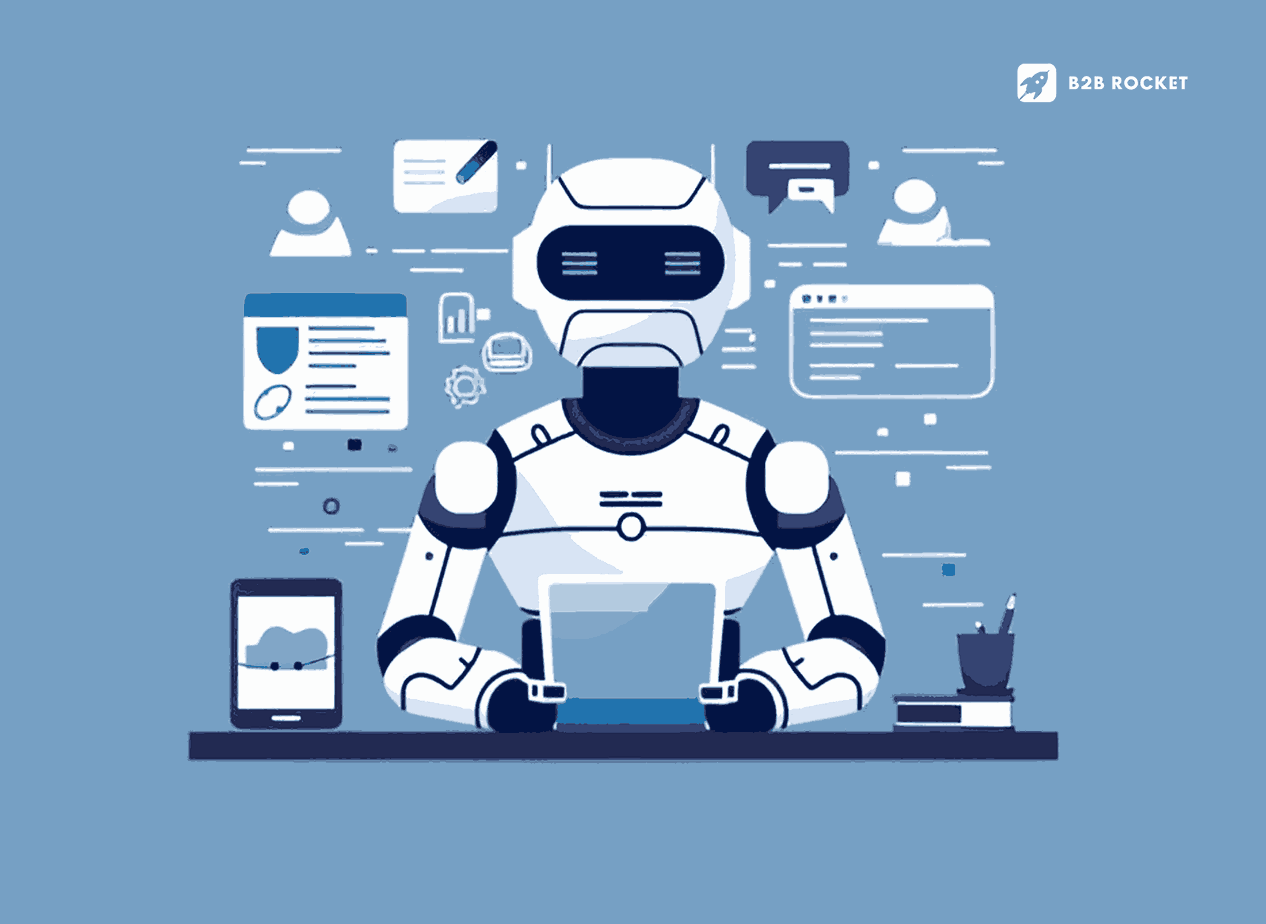
If I zoom out, the contrast comes down to engines. A human-led agency like IronPaper brings real strategic value, but it moves at human speed and scales with people. An AI platform engages leads in seconds, optimizes continuously, works from fresher data, and covers the globe around the clock.
That is exactly what we built a B2B Rocket to do. Our AI agents respond in seconds, tune campaigns in real time, and run worldwide without adding a single seat, so your pipeline keeps moving while you sleep. If speed-to-lead and pipeline velocity are what win your deals, this is the model built to win them. Take AI speed for a spin and feel the difference.
Faster is better, and the gap is dramatic. Contacting a lead within five minutes makes you far more likely to connect and qualify, while the average team still waits around 42 hours. Aim for near-instant on high-intent leads, and use automation to hit sub-60 seconds reliably rather than hoping a person is free.
It can handle the continuous, repetitive optimization that humans cannot do at scale, like testing variations, learning from every send, and adjusting in real time. Strategy and creative direction still benefit from human judgment, but the moment-to-moment tuning is where AI clearly pulls ahead.
Yes. AI agents run 24/7 and engage accounts in parallel across time zones, so you get always-on global coverage without staffing regional teams or night shifts. That is a big advantage for ABM programs that span multiple markets.
Book more deals and drive revenue on autopilot with Al agents, real data, and multichannel outreach.

Work 24/7 to find, engage & qualify leads.

48+ contacts to reach the right people.
.svg)
Email, calls, Linkedin & more. All in one place.
Automate, optimize & close more deals.


.jpeg)
.jpg)






.svg)
.svg)
.svg)
.svg)

